Andrius: I'm sharing my understanding of counterquestions and their practical applications.
Counterquestions
Introductory dilemma: How do I know I am not a robot?
YouTube: Math4Wisdom: How do you know that you are not a robot?
A teacher once asked me, How do you know you're not a robot? and I realized that I could best respond to such a doubt with a counterquestion, Would it make any difference?
Doubts and counterquestions
A workshop participant, Bob Weinberg, once asked me, How do we know you're not brainwashing us? and so I collected such counterquestions. I collected some 30 examples from my personal experience and distilled them down to the following seven.
- Do I truly like this? How does it seem to me?
- Do I truly need this? What else should I be doing?
- Is this truly real? Would it make any difference?
- Is this truly problematic? What do I have control over?
- Is this truly reasonable? Am I able to consider the question?
- Is this truly wrong? Is this the way things should be?
- Am I truly anxious? Am I doing anything about this?
A counterquestion places a perspective in a situation
If we consider the counterquestions, we see that each of them
- takes one of three perspectives: God's, a person-in general, or a person-in-particular
- considers one of three situations: a person-in-general, a person-in-particular, or the world
But apparently the perspective and the situation must differ. This yields seven possibilities, structured as follows
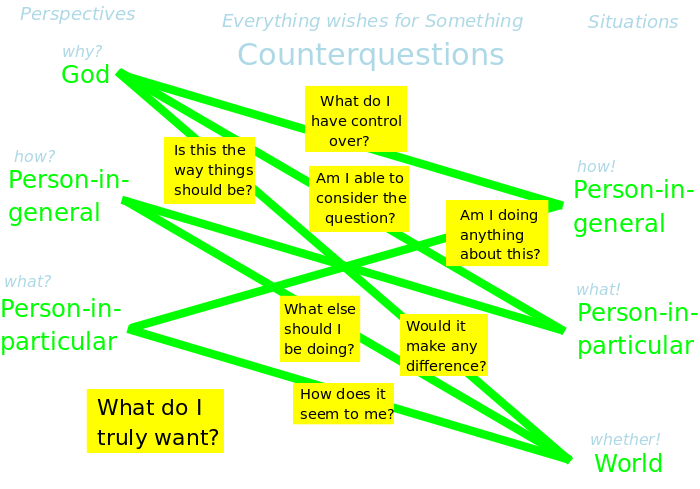
We can also posit an eight counterquestion which is prior to any doubt, thus prior to any perspective or situation, but rather evokes our certainty: What do I truly want?
Examples of this structure
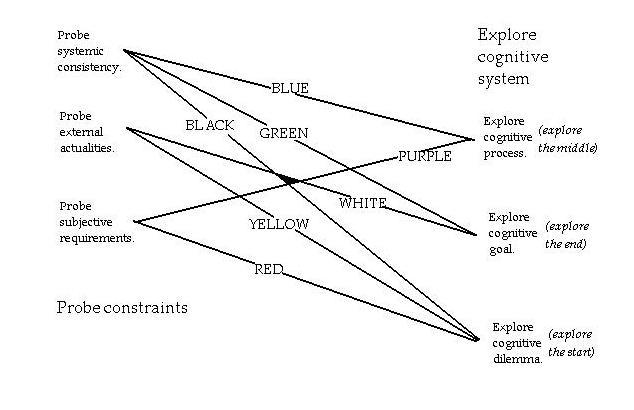
Edward de Bono's thinking hats
Jesus's antitheses in his Sermon on the Mount
- How does it seem to me? "Everyone who gazes at a woman to lust after her has committed adultery with her already in his heart."
- What else should I be doing? "First be reconciled to your brother, and then come and offer your gift."
- Would it make any difference? "For if you love those who love you, what reward do you have? Don’t even the tax collectors do the same?"
- What do I have control over? "Neither shall you swear by your head, for you can’t make one hair white or black."
- Am I able to consider the question? "Give to him who asks you, and don’t turn away him who desires to borrow from you."
- Is this the way things should be? "Whoever puts away his wife, except for the cause of sexual immorality, makes her an adulteress."
Stephen Covey. Seven Habits of Highly Effective People
Stephen Covey comprehensively studied the habits of highly effective people.
- How does it seem to me? Seek first to understand then to be understood. Influence others by developing a deep understanding of their needs and perspectives.
- What else should I be doing? Put first things first. Prioritize and achieve your most important goals instead of constantly reacting to urgencies.
- Would it make any difference? Begin with the end in mind. Define clear measures of success and a plan to achieve them.
- What do I have control over? Be proactive. Focus and act on what you can control and influence instead of what you can’t.
- Am I able to consider the question? Sharpen the saw. Increase motivation, energy, and work/life balance by making time for renewing activities.
- Is this the way things should be? Synergize. Develop innovative solutions that leverage differences and satisfy all key stakeholders.
- Am I doing anything about this? Think win-win. Collaborate more effectively by building high-trust relationships.
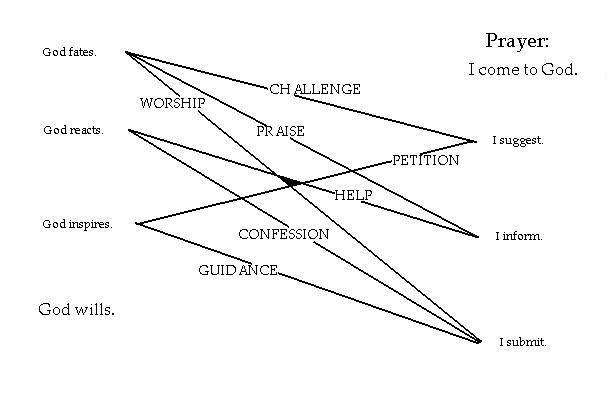
The kinds of prayer
I did a study of the kinds of prayer.
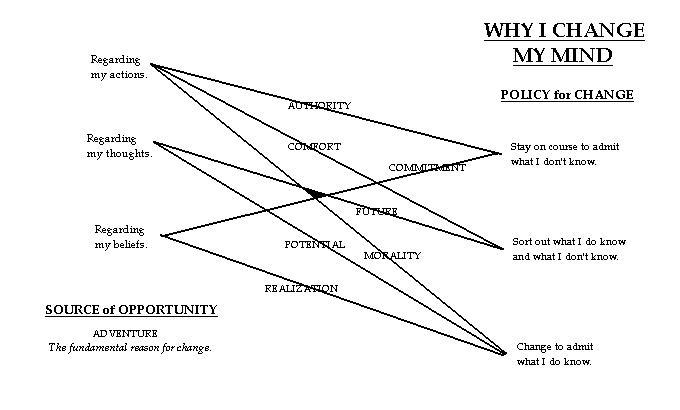
The reasons we change our mind
Joe Damal and I did a study of the reasons people change their minds.
Principles for nonviolent engagement
Joe Damal and I distilled our insights into nonviolently engaging the violent.
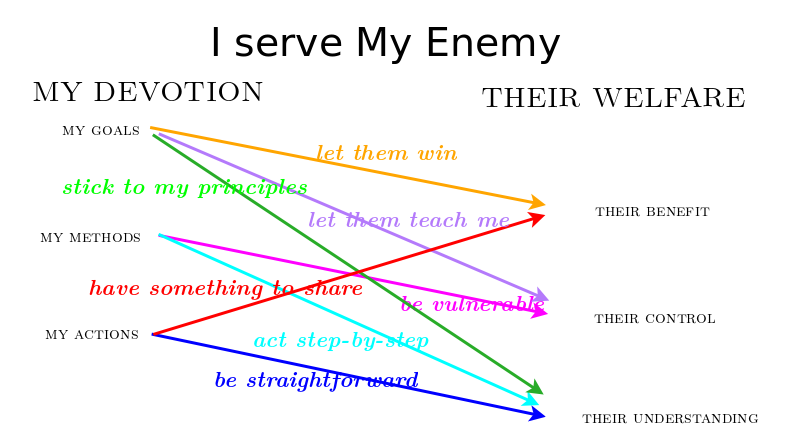
In Chicago, I and Joe Damal had distilled our personal experience engaging gangs into an overall principle, "Always look at everything from their point of view", and seven related precepts: Be straightforward, Don't skip steps, Be vulnerable, Let them win, Let them teach you, Stick to your principles, and Have something to share. But I needed metaphysics to assure myself that these precepts were so correct and so complete that we could depend on them with our very lives.
In the midst of the Kenyan crisis of 2008, Rachel Wambui Kungu of the Pyramid of Peace recounted their success in convincing the youth at Naivasha, who were armed with machetes, to leave their roadblocks and allow food, medicine and refugees to go through. She thanked me for the precepts I had taught her, such as "Be vulnerable". Instead of driving up in a car, her team went on motorbikes, which put the youth at ease.
See also:
- A Peacemaker's Way: Wake Up, Love Your Enemy, Befriend Evil
- Bring Peace to Russia and Ukraine
- Pyramid of Peace
The greater context: Four such eightfold structures
The counterquestions express the mind's intelligence. They are the options available for transcending the mind that knows.
But we are more than just our mind. We are body, mind, heart and will. There is an eightfold structure for each of these.
YouTube: Math4Wisdom: 3 Minds Linked In 4 Ways. Consciousness in Body, Mind, Heart, Will