See: TimberFish Technologies and Language of Wisdom
Ecological Intelligence: Introduction:
For over 60 years I have studied science, microbiology, biophysics, and theoretical biology, and I have worked extensively with applied ecotechnology in municipal wastewater treatment, nutrient and manure management in large animal agriculture, and aquaculture. I believe in the science that uses real number measurements for distance, area, volume, and time, and the derivative concepts of mass, energy, and charge. I also believe in the atomic hypothesis and the chemistry which comes from the periodic table of the elements. All of this can be calculated and computed with real numbers.
In addition, quantum mechanics has shown that some phenomena, particularly atomic and sub atomic behavior, require the use of complex numbers which cannot be explicitly computed. All of this science and its supporting mathematics is extremely powerful and useful in describing a large area of my personal experience.
But not all. While this has always been a concern it has recently become increasingly troublesome. I have not found instances in Nature where organisms use real number computations to make decisions or direct their actions. This also appears to apply to how artists create their work, and even to most of my own life. I don’t compute probabilities to help me choose what kind of ice cream I want to eat.
An alternative hypothesis to explain this is Ecological Intelligence. The premise is that biological organisms function with instinct, emotion, and an intuitive understanding of how all things are connected. Various forms of language-like phenomena assist in this. These include; the DNA, RNA, and protein genetics of all known biological organisms; a variety of chemical signals that are emitted and received by a wide variety of microbes, plants, and animals; the neurotransmitter system of larger animals, including humans; and the early linguistic systems of indigenous peoples and even many of our modern natural and artificial languages which are not based on computational procedures and systems.
The term Ecological Intelligence has been used by many authors to describe these types of phenomena. What differentiates the present work is that the concept of Ecological Intelligence is linked to applied ecotechnologies where it provides specific protocols and procedures for system design and operation. Applications include municipal and industrial wastewater treatment, manure and nutrient management for large animal agriculture, and ecologically integrated agriculture and aquaculture.
Ecological Intelligence: A Model of a Biological Way of Thinking
Why do we need Ecological Intelligence? Because there are some problems that science cannot solve.
When we are born we are aware of ourselves, our parents and family, and lots of other stuff out there. As we grow we develop understanding. We learn language and increasingly detailed descriptions of our personal experiences. We become functional adults in a global society. Eventually, some of us also become aware that we as individuals, our social structures, and our environment might have some significant problems. From my personal perspective these comprise increasing environmental pollution and destruction (Climate Change), a rise of excessive wealth inequality, and an increase and concentration of autocratic forms of governance.
These problems have emerged as unintended consequences of the tremendous development of human technology over the last 6,000 years and its acceleration that started some 400 years ago with the rise of the physical sciences. This has driven a dramatic rise in human population and a significant improvement in the quality of life for many.
It has also allowed society to become way more complex and difficult to understand. This makes machine like structures and simple strongman solutions to problems attractive to many people. They become easy ways to cope with complex situations. Unfortunately, this also allows these structures and solutions to be exploited by a few for their own personal advantage at the expense of the rest of us, and this is what generates the problems mentioned above.
Consider Ecological Intelligence (EI) as a tool that may allow all of us to do something about this. Define EI as the fundamental structure and process by which biological ecosystems and their constituent organisms and subecosystems make decisions. I now assume that these decisions are primarily based on prior experience, instinct, emotion, and a consequent intuitive understanding that initiates all the actions by which the ecosystems and organisms function and evolve on our planet Earth. This view of EI does not rely on computation, or natural languages, or symbolic formalisms such as mathematics or symbolic logic, to make such decisions.
For many years I believed that the computational and analytical tools of mathematics and science were the main factors, or at least approximations, of how humans behaved. Thus entropy, particularly maximum entropy, seemed like the best model for us to use to make decisions. Even if this was mathematically complicated for all but the simplest situations. The normed division algebras also seemed to be the best way to predict behavior. They appeared to be useful and successful, even at the atomic quantum mechanical level.
50 years of working with ecotechnological systems, and living with a brilliant and very non computational artist, have now begun to change my mind. Over my ecotechnology career I have seen no actual evidence that these computational factors play a role in the behavior of biological (non human) organisms in our environment. They certainly are not the factors in how artists function. This seems to leave instinct, emotion, and an intuitive understanding as the best possible alternatives to understand how organisms and ecosystems function as Ecologically Intelligent.
This has led to an understanding that the normed division algebras, entropy, the maximum entropy principle, and the Goldilocks quaternion formulation of the maximum entropy principle are all numerical or quasi numerical approximations that derive from the basic structure of Ecological Intelligence. Thus they all represent different views of the personal experience, instinct, emotion, and intuitive understanding patterns of Ecological Intelligence.
This is a one way street. It is like time in that it only goes one way. You can’t start with binary numbers and derive entropy and the normed division algebras, let alone instinct, emotion, and understanding.
Instinct is genetic. It derives from our DNA, RNA, and proteins. Emotion is what we experience when we combine our personal experience, our actions, with how we view our instinctive idea of what that personal experience is, or what it was expected to be. The total combination and interrelation of these personal experiences with our instincts and emotions then leads us to develop an intuition as to what to expect for future personal experiences. None of this needs to involve computation to explain how all living biological organisms function.
Most of us already have some sort of intuitive understanding of EI and it does seem to have a basic structure that is a pattern for the normed division algebras in modern mathematics. Thus the hypothesis is that we may be able to solve some of our major current problems by combining this vision of EI with science in those problem areas where science has not been successful, problems that are difficult to measure with real numbers and solve by writing equations.
Given our current understanding of the universe and the origin and evolution of life, it appears that EI has been developing for a long time. It occurs and has occurred as a dominant characteristic of all of life as we know it. This includes each organism, each species, and the constituent ecosystems and environments within which they all live.
As we humans have evolved EI was expressed by our spoken languages and art, and the ornamentation, tools, structures, and organizations we created. Then we started writing, started creating a symbolic formalism that could persist beyond the life of any individual. Writing extended the capabilities of EI into a new Human Intelligence that incorporated measurement with numbers and calculations, which were not generally present in the rest of the biological universe.
Knowledge about the use of number and measurement existed in language before writing but with this new capability its use and sophistication expanded rapidly. This in turn led to the development of modern mathematics, science, and the adoption of the reductionist paradigm as major factors in Human Intelligence. Unfortunately, an overshadowing of EI at the societal and environmental level has now led to the problems mentioned before, Climate Change, widespread environmental pollution, extreme wealth inequality and increasing autocratic governance.
We all still use EI in our daily lives but the success and power of our emerging scientific Human Intelligence has essentially replaced EI at the political, economic, and environmental level. These are complex organizational levels where measurement and mathematics often give indeterminant results that are difficult to understand. This provides an opportunity for a few to provide manipulated versions of the results which then support decisions and practices that benefit themselves at the expense and exclusion of many others. Reincorporation of EI in these areas should allow us to correct the problems we have created with an over reliance on science and mathematics in such areas where measurement is often not possible or accurate.
The rest of this document will provide some examples of EI to create an intuitive understanding of what it is and how it is relevant to your own personal experience. It will also trace the historical development of EI, how Human Intelligence evolved from EI, and how this has generated some of the critical problems and issues that humanity is currently facing. A final section will provide more discussions as to what EI is, how it works, why it is important, and how all of us can lead happy and more sustainable lives by being aware of it.
Example 1 Through Art: Look at the sculpture and philosophy of Lynn Northrop. See Lynn Northrop
I now believe that Lynn’s art, and the process by which she creates her art, are the most inspirational and profound expressions of what I am calling Ecological Intelligence. The concept is that everything is interrelated in a multitude of ways and that this can be illustrated with objects that comprise many different materials and things. Each object has connections and history with all aspects of our human personal experience. The combination of all these things makes them powerful. They illustrate the incredible connectivity and evolutionary capability of who we are, our universe, and the planetary ecosystem within which we live. Here are two examples and a sample of how she describes her work.
 |  |
"My work is entirely made of stories. Art is a dialogue between the artist and the viewer but my raptors add additional voices to the conversation. Since my birds are comprised of objects once owned or worn or used by others, their voices too must be included and their stories heard.
Some objects are easily discarded, some, even though they have no monetary value, are kept for generations. These are the true connectors to people who are absent, to places once enjoyed, or to a story often retold. These objects can be anything – a shell, a pen, a key that magically becomes meaningful, the things that become heirlooms, souvenirs, love tokens, or good luck charms.
We are connected through the stories that these objects tell. Old tools that were carried to work every day, worn machine parts no longer essential, and schoolroom dip pens no longer in fashion. Some objects tell their own stories: the worn thin masonry trowel, the old Christmas tree stand, the carnival mallet beat to shreds by strong men, and the student violin. All are parts of my birds.
Some objects have a backstory like the box of rusty straight razors from my husband’s grandfather that became wing bars in one of the birds, or the basket, given by a friend that became the breast of another. There are many odd bits and pieces donated by friends and strangers that are incorporated in my work. Feathers, seeds, stones, and bones add the voices of Nature with stories of weather, hardship, and the wonder of survival.
All these voices, when combined in my birds, become amplified and tell of the connectedness of all things. Art can do that. They tell of the journeys these objects have taken, the many hands that have held them, used them, loved them, … including my own."
While art and an aesthetic interaction lead the way in understanding EI there are many additional paths to follow. These include:
Example 2, Through the building and operating of ecotechnology systems:
See the TimberFish Ecotechnology systems which range in size from Table Top - Basement Models to Commercial Systems. These are described in detail on this site. See: TimberFish Technologies
 | 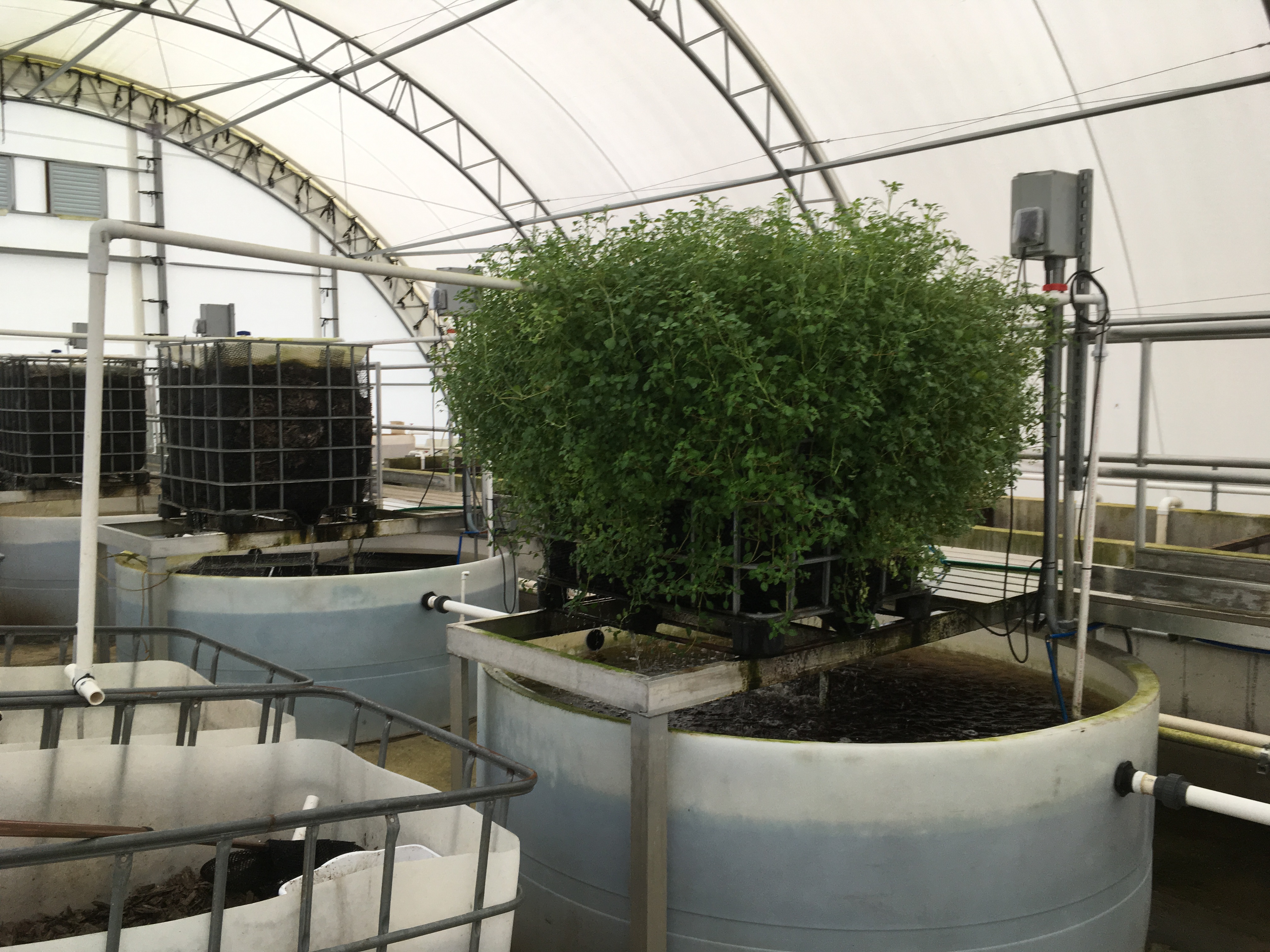 |
Also a general introduction to the development and application of Ecological Intelligence to aquaculture is presented here. Ecologically Intelligent Aquaculture
3 Through constructing and using Languages of Wisdom: Examples. See the Divisions of Everything and Derivation of Archetypal Meaning on this site, at Language of Wisdom
These Languages of Wisdom do not need words but communicate structure and function through the use of symbolic formalisms.
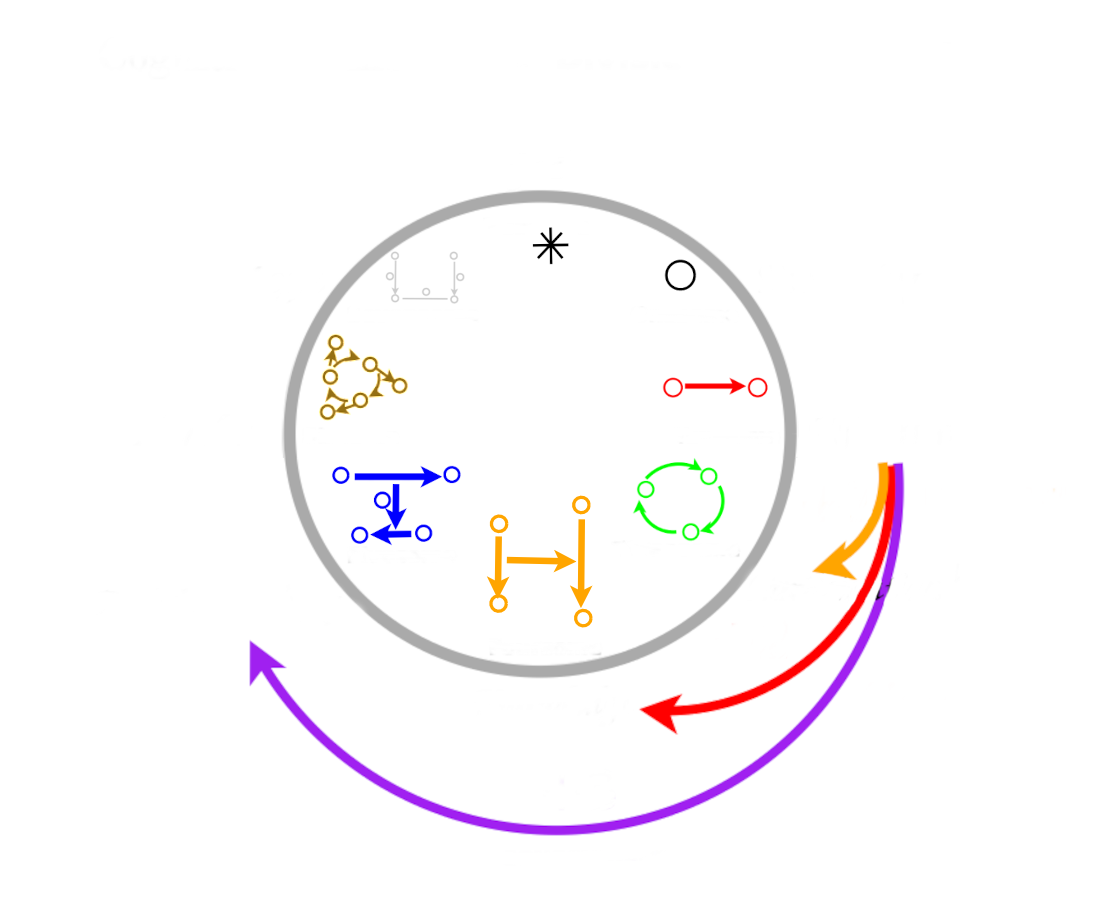 | 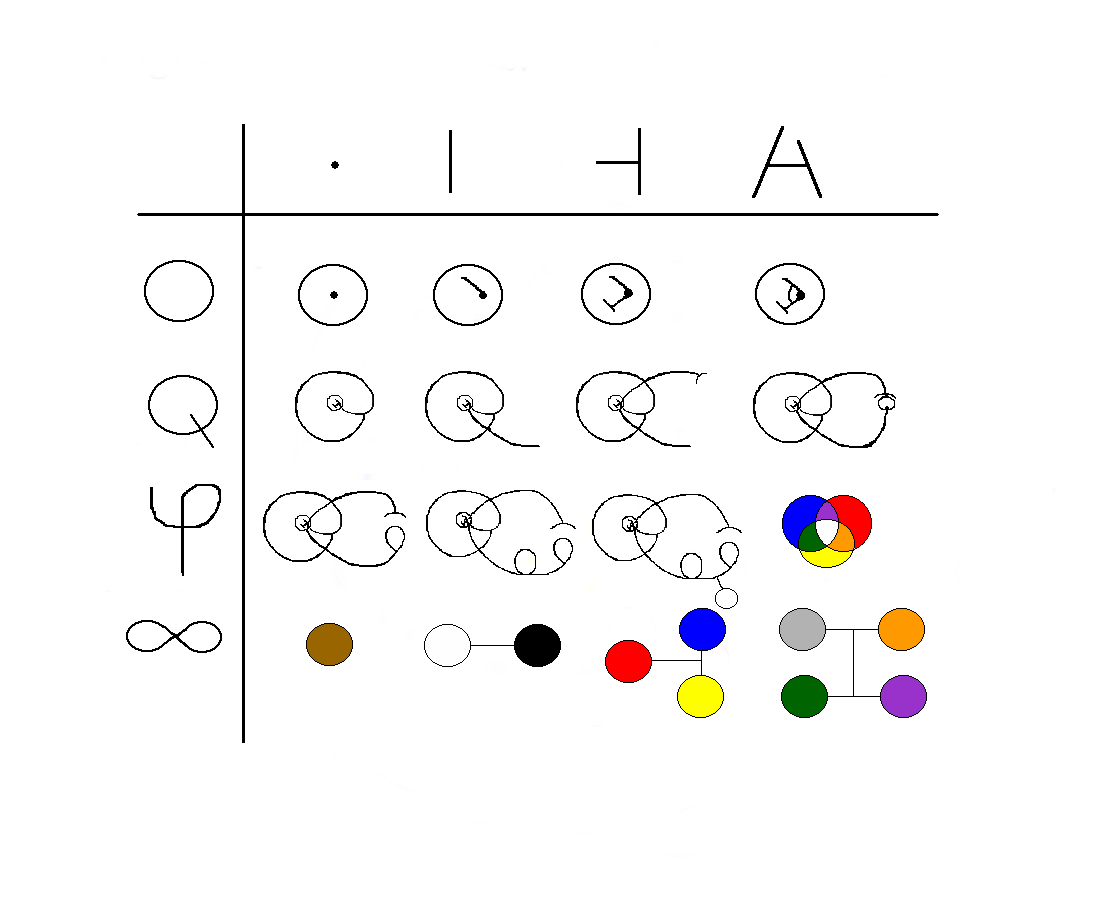 |
Here is a pattern prelanguage for EI. EI PatternPreLanguage
4 Through advanced mathematics: Example. The success of Modern Physics and its derivative technologies points to a requirement of including the normed division algebras into our descriptions of our personal experiences with a perceived external reality. Specifically, consider the necessity of using quaternions in Quantum Mechanics. This introduces a level of uncertainty in our descriptions of individual particle behavior. This can be expanded into our notion that particles could be organisms and that the structural patterns of the quaternions and octonions could be guidelines for successful human behavior. See Math 4 Wisdom for more mathematical background. Here is a basic representation of a quaternion where i is equal to the square root of minus one,
 |
Since the normed division algebras are modeled after the basic patterns of EI their success provides credibility for the more general patterns in EI itself.
5 Through study and interaction with Indigenous Peoples.
Many Indigenous communities have a culture and tradition that comprise a comprehensive way of life, or a way of knowing. This includes a deep relationship with their land which they consider to be a living entity inhabited by spirits who guide and help them. It also includes all other living things as well as inanimate objects which are often viewed as have a spirit or soul. This gives them a profound sense of stewardship of their environment and a desire to live their lives in a balance that sustains both the earth and themselves. For example see “Sacred Instructions” by Sherri Mitchell, 2018, North Atlantic Books.
EI supports these world views and offers an explanation as to why they are valid in many areas where existing science cannot measure or quantitively describe our personal experiences. Many indigenous languages are passed on via oral traditions and thus have not been subjected to representation with the types of complex symbolic formalisms that have led to advanced mathematics. Thus there has been no incentive to try to explain all of our personal experiences scientifically with measurement and equations. Consequently a sensitivity and empathy with Nature remains as the primary guide as to how to live and function.
To get a sense as to where EI comes from consider our current model of the universe, or at least our relatively local part of it. We and all other known living organisms live in an ecosystem on a planet which revolves around a sun, and all of this exists in a larger mostly empty space. The planet receives energy in the form of light from the sun, and since the planet rotates as it revolves around the sun, the ecosystem on the surface of the planet experiences alternating periods of light and darkness. The periodic flow of energy through the atomic substances on the surface of the planet has an organizing effect and this is what generates evolution. An approximate historical timeline in years for life and its evolution on our planet is as follows.
4.5 billion origin of the earth
3.5 billion origin of life on earth procaryotes bacteria and archaea, photosynthesis by cyanobacteria
1.8 – (2.7) billion origin of eukaryotes
1.6 billion origin of plants, multicellular organisms
574 million origin of animals
3 million origin of stone technology by early humanoids
1 million origin of fire technology which led to cooking and pottery
200,000 to 300,000 origin of modern humans homo sapiens
18 thousand ceramics
6,000 – 5,500 years ago urban civilizations Sumerians (4,000 – 3,500 BC), includes first writing, cuneiform
There are a large number of languages and actions that organisms and ecosystems have used in this historical development. This started with the inclusion of nucleic acids (RNA and DNA) as codes in the initial biological organisms. Over the course of millions of years certain additional patterns have evolved in Nature that enhance this linguistic capability in our particular planetary environment. By observing and working with Nature we can get a sense of these patterns. Describing them will give us a path to follow to learn and understand EI. Consider the following examples of behavior that exemplify EI.
First, In Nature there is no waste. Everything is recycled and balanced. Plastics, forever chemicals, and nuclear wastes are not produced. Instead Nature reuses what it produces. Indigenous peoples and forest ecologists have long taught that when a tree dies in the forest its story is only half over. As it degrades it provides homes and food for a variety of birds, animals, insects, and microbes. Eventually returning back into the soil from which it initially sprang.
Second, Nature is essentially democratic. Organisms usually make their own decisions and this is not dependent on other similar organisms of the same species. There are local exceptions of this but they usually apply to situations related to mating or survival in situations where food is scarce. An example is the alpha leader of a pack or herd.
Third, organisms do not collect and store food or other resources in extreme excess for a perceived future need. There is no extreme wealth inequality. An example is the amount of seeds or nuts that rodents store or hide for an expected future need such as for winter. This is limited to what the individual organism can actually do by itself and does not involve coercion or control of other organisms to achieve the collection of wealth.
Fourth, virtually all organisms and ecosystems operate with the same form of energy “currency”. This involves photosynthesis and the oxidation of carbon and hydrogen in organic molecules. Other forms of chemical oxidation and reduction reactions do occur but they are not the basis of our global ecosystem and its constituent ecosystems.
You will notice that in our current human society we don’t normally follow all of these EI patterns. This contrasts with what was our normal behavior for millions of years before we recently developed technology and urban civilization.
By reintegrating EI types of understandings into our current Human Intelligence we can resolve some of our current problems that have arisen or been enhanced by our obsessive focus on machine like technology instead of biological processes. We can do this by using EI in our personal daily lives and the social interactions we have as members of our human society and our global ecosystem. Working with ecological systems and ecotechnology will provide guidance and understanding of how Nature has been so successful for a billion years.
Here is a one page summary of EI. Ecological Intelligence Summary